Blog
Voice Caddie SC300i vs SC200 Plus: the budget swing-speed decision
One is $179.99, the other is $399.99, as of Nov 3, 2026. Both measure swing speed without a subscription. What the extra $220 buys.
By the My Golf Obsession teamPublished Nov 3, 2026
Voice Caddie
Intro
If you only want to know how fast you swing and how far each club goes, the cheaper unit already answers that question. The $220 gap, as of Nov 3, 2026, buys launch angle, apex height, app-based spin, and a rechargeable battery, not a different kind of practice.
Both units sit about 5 feet behind the ball and use K-band 24 GHz Doppler radar. Both call out your carry distance after each shot. Neither needs a subscription for its core numbers, and neither plays simulator golf. The choice is about how much data you want to keep, not about whether the cheaper unit is a toy. It is not.
The Voice Caddie SC200 Plus is $179.99 at Voice Caddie direct as of Nov 3, 2026, a sale price confirmed on our SC200 Plus deal page. The Voice Caddie SC300i is $399.99 as of Nov 3, 2026. Check the deal pages linked below for the live price before you buy, since sale prices end without warning.
What each one measures
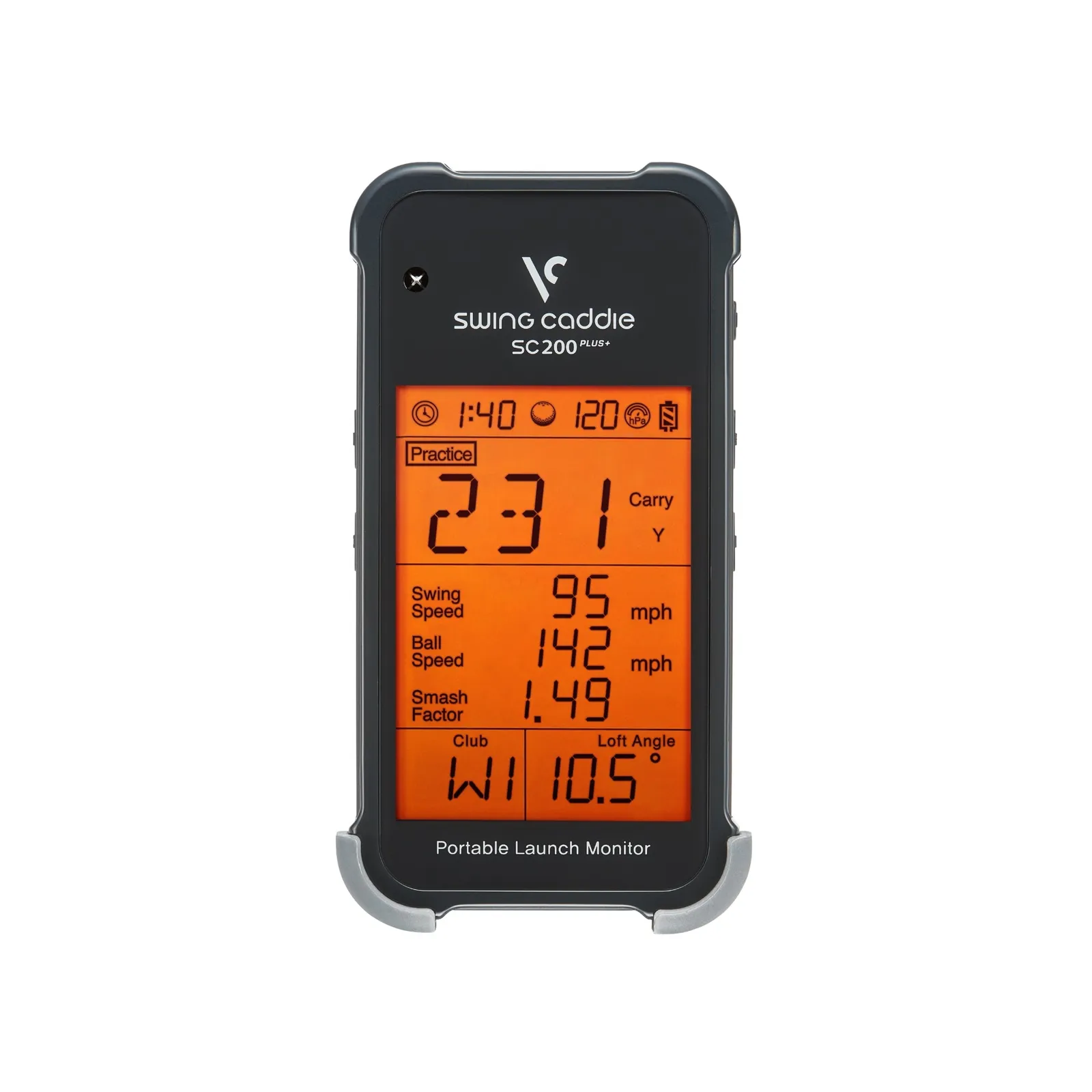
The shared core is the same, and it covers most range work:
- Carry distance and total distance
- Swing speed
- Ball speed
- Smash factor, which is ball speed divided by swing speed
The SC200 Plus stops there. It has no launch angle, no apex height, and no spin rate. Its total distance is an estimate, because it measures carry and then estimates rollout.
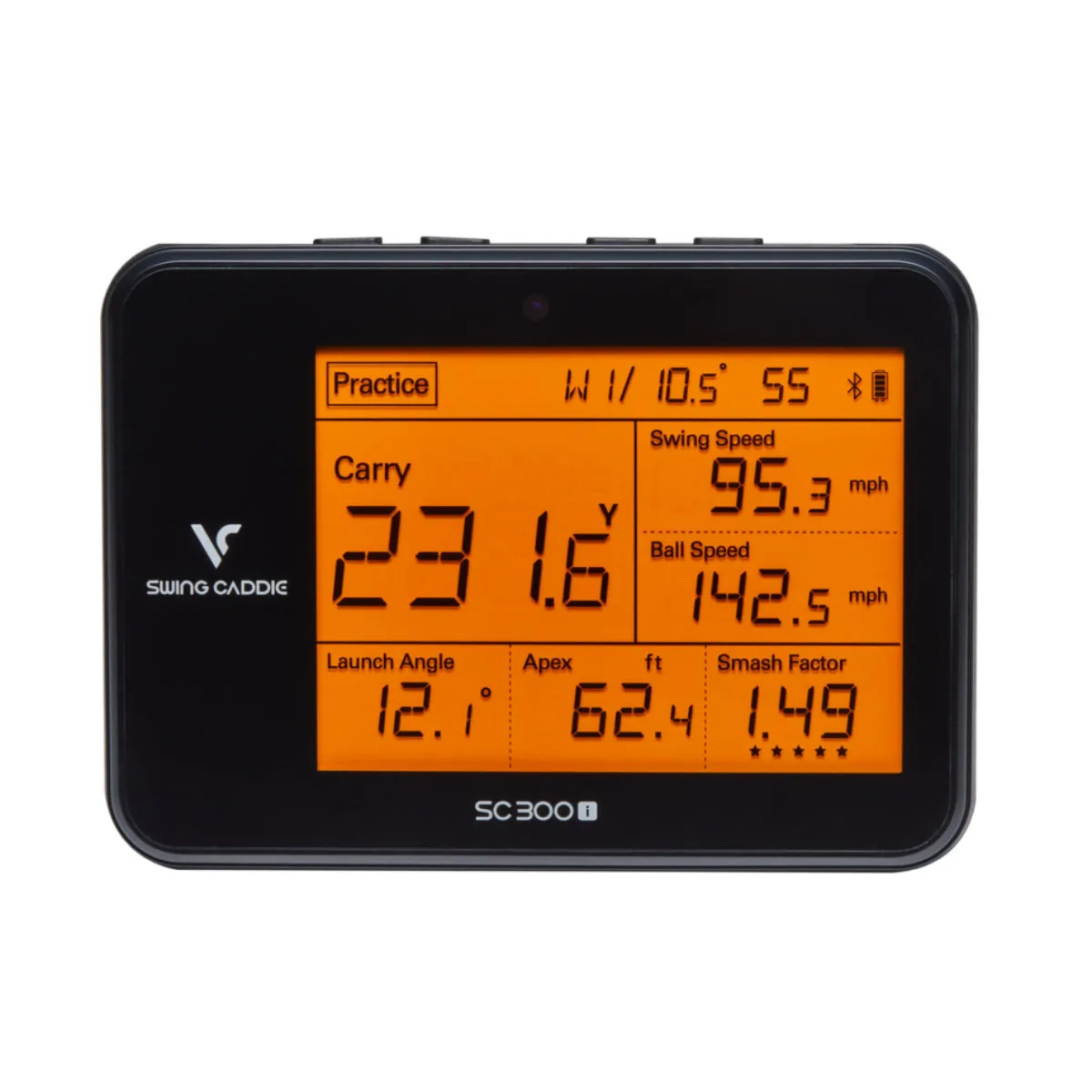
The SC300i adds three things, on the device or in its app:
- Launch angle, shown on the device
- Apex height, the highest point of the shot, shown on the device
- Spin rate, shown only in the MySwingCaddie app, not on the device screen
That extra set matters for one specific golfer: the player who is gapping wedges by launch and flight, or checking whether a new shaft actually lowers spin. If your practice is mostly "how far did that go, and was my swing speed up," the SC200 Plus already gives you the numbers you will act on.
Side by side
- Price as of Nov 3, 2026: SC200 Plus $179.99 at Voice Caddie direct, SC300i $399.99
- On-device metrics: SC200 Plus 4, SC300i 6, plus spin in the app
- Display: SC200 Plus 4 inch LCD, SC300i 5.3 inch LCD
- App: SC200 Plus none, SC300i MySwingCaddie over Bluetooth
- Measuring range: SC200 Plus 30 to 320 yards, SC300i 10 to 370 yards
- Placement: both about 5 feet behind the ball, at ball height
- Power: SC200 Plus 4 AAA batteries, up to 20 hours; SC300i rechargeable lithium polymer battery, up to 20 hours, charged over USB-C
- Simulator play: neither. The SC300i does not work with E6 Connect or other simulator apps, per Voice Caddie.
The range difference deserves a second look. The SC200 Plus starts at 30 yards, so very short chips are outside its window. The SC300i starts at 10 yards, which makes it the better short-game tool. At the top end, 320 yards covers most amateur drivers, and 370 yards covers the rest. Only the longest hitters will notice the SC300i's extra headroom.
Display and usability
Both units are built for a range session with no phone fuss, but they diverge once the session ends. The SC200 Plus shows everything on its own screen, stores per-club averages on the device, and needs no pairing, no account, and no charging cable. You drop in AAA batteries and go. Its remote changes clubs and modes from your hitting position.
The SC300i keeps that same stand-alone habit, with a larger screen and a remote, and adds the app when you want it. Pair MySwingCaddie over Bluetooth and you get spin rate, shot history, and per-club statistics on your phone, plus video overlay in the app. The app is a bonus, not a requirement. The unit works fully without it, and there is no subscription for the device or the app.
Practice modes are close cousins. The SC200 Plus offers Practice, Target, Approach, and Practice Swing modes. Practice Swing mode reads swing speed with no ball at all, which makes it a genuine speed-training tool at home. The SC300i offers Practice and Target modes, with target distances from 15 to 195 yards in 5 yard steps, while the SC200 Plus targets from 40 to 200 yards. If speed training without a ball is the main goal, the cheaper unit actually has the dedicated mode.
Accuracy expectations at this price
Put plainly, these are radar estimates built from swing speed, ball speed, and the loft you enter, not camera measurements of the ball in flight. That is fine for gapping and speed work, and it is the wrong tool for diagnosing face angle, path, or strike location. Neither unit measures those.
Voice Caddie publishes tighter tolerances for the SC300i: plus or minus 2 percent on ball speed, and plus or minus 3 yards on carry in target mode, or plus or minus 3 percent in practice mode. The SC200 Plus is rated plus or minus 3 percent on ball speed and plus or minus 5 percent on carry distance. On a 150 yard carry, that SC200 Plus carry tolerance is about 7.5 yards, against about 4.5 yards for the SC300i in practice mode.
Treat both numbers as range-grade, not fitting-grade. Use them to compare clubs, track speed trends, and spot a bad strike pattern across a session. Do not use either one to argue over two yards on a single shot, and do not expect either to explain why a shot curved. Neither measures direction.
Who should buy the SC200 Plus
Buy the SC200 Plus if you want the simplest possible launch monitor, you practice mostly at the range or into a net, and your questions are carry distance, swing speed, and speed training. At $179.99 as of Nov 3, 2026, it is less than half the SC300i's price, and it answers the questions most golfers actually ask after a session.
Buy it in particular if you like the idea of no phone, no charging, and no app. AAA batteries are a feature here, not a compromise, for a unit that lives in a golf bag. Keep a spare set of batteries in the bag and the unit is always ready.
Who should step up to the SC300i
Step up to the SC300i if you want launch angle and apex on the device, spin in the app, a wider measuring range that reaches down to 10 yards, and a rechargeable battery with a bigger screen. That buyer is usually working on trajectory, not just distance: flighting wedges down, checking launch on a new driver, or comparing spin across balls.
The SC300i is also the better pick if you want a session record on your phone. Shot history and per-club statistics in MySwingCaddie turn a range bucket into a trend line, and that trend line is what tells you whether a swing change is working. The SC200 Plus keeps averages on the device, but it will not hand you a history you can review at home.
Skip both if simulator golf is the goal. Neither connects to GSPro, E6 Connect, or any other simulator software. For course play, the next step in this same family is the SC4 PRO, not a more expensive version of either unit here.
The verdict
At $179.99 as of Nov 3, 2026, the SC200 Plus is the value pick. The sale price makes an already clear gap wider. It measures the four numbers that drive most practice, needs no phone, and has a Practice Swing mode for speed training without a ball. The SC300i at $399.99 earns its extra $220 only if launch angle, apex, app-based spin, short-game range, or a rechargeable battery will change how you practice. If none of those changes a session for you, keep the $220, buy the SC200 Plus, and spend the difference on range balls. Before you buy, check our Voice Caddie SC200 Plus deal page and our Voice Caddie SC300i deal page for live prices.
Sources: Voice Caddie's SC300i product page for metrics, E6 incompatibility, and the $399.99 price; our deal pages for the $179.99 SC200 Plus price as of Nov 3, 2026 and the SC300i price; Voice Caddie retailer specifications for ranges, displays, batteries, and accuracy tolerances.
Shop the post