Blog
SwingTurf vs Super Softy vs Pro Turf: Which mat for which golfer?
Three mats on the site, three feels, three prices. Your wrists and your wallet notice the difference.
By the My Golf Obsession teamPublished Oct 29, 2026
Image via MyGarageGolf
The takeaway is simple. These three mats solve three different problems. SwingTurf is the everyday simulator mat at a fair price. Super Softy is the permanent, shared bay mat that costs more and stays put. Pro Turf is the net-and-putting mat that rolls up and goes away when practice ends. Buy the one that matches how you practice, not the one with the longest spec list. Prices below are as of Oct 29, 2026, and the deal pages carry the live price.
SwingTurf: the everyday simulator mat
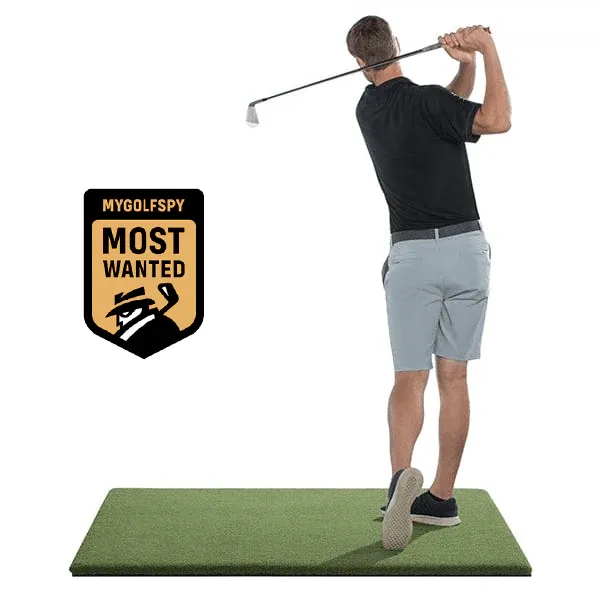
SwingTurf is Rain or Shine Golf's in-house mat, and it is the default mat in the company's SwingBay simulator packages. The hitting surface is a fiber system over 5/8 inch high density foam, 1.7 inches tall overall. The idea is to hit down and through the ball the way you would on a real fairway, with the strike absorbing into the fibers instead of skipping the club across plastic. Rain or Shine says the softer surface noticeably reduces recoil and vibration compared with cheap mats, and that is the claim that matters most for daily practice.
Sizes and prices, verified from Rain or Shine on Oct 29, 2026: 4 ft by 4 ft at $399, down from a $449 list price, 32 pounds; 5 ft by 5 ft at $549, 45 pounds, the center hitting standard the company ships in most SwingBay packages; 4 ft by 7 ft at $749, 53 pounds; 4 ft by 9 ft at $849, 63 pounds.
Every size takes a real wooden tee anywhere on the surface, at any height, which is a genuine convenience for driver practice. No fixed rubber tee inserts to work around. The mat is rated for indoor and outdoor use, and it ships with alignment sticks included. The 3 year warranty is backed directly by Rain or Shine, with a lifetime extension available at checkout.
The honest limit is wear. SwingTurf has no separate hitting strip to replace. The whole surface is the hitting surface, so when the strike zone eventually wears, you are replacing a mat, not a strip. At $549 for the 5 by 5, that is a fair trade for most home golfers. It is not the mat for a commercial bay running all day, every day.
Super Softy: the permanent shared bay mat
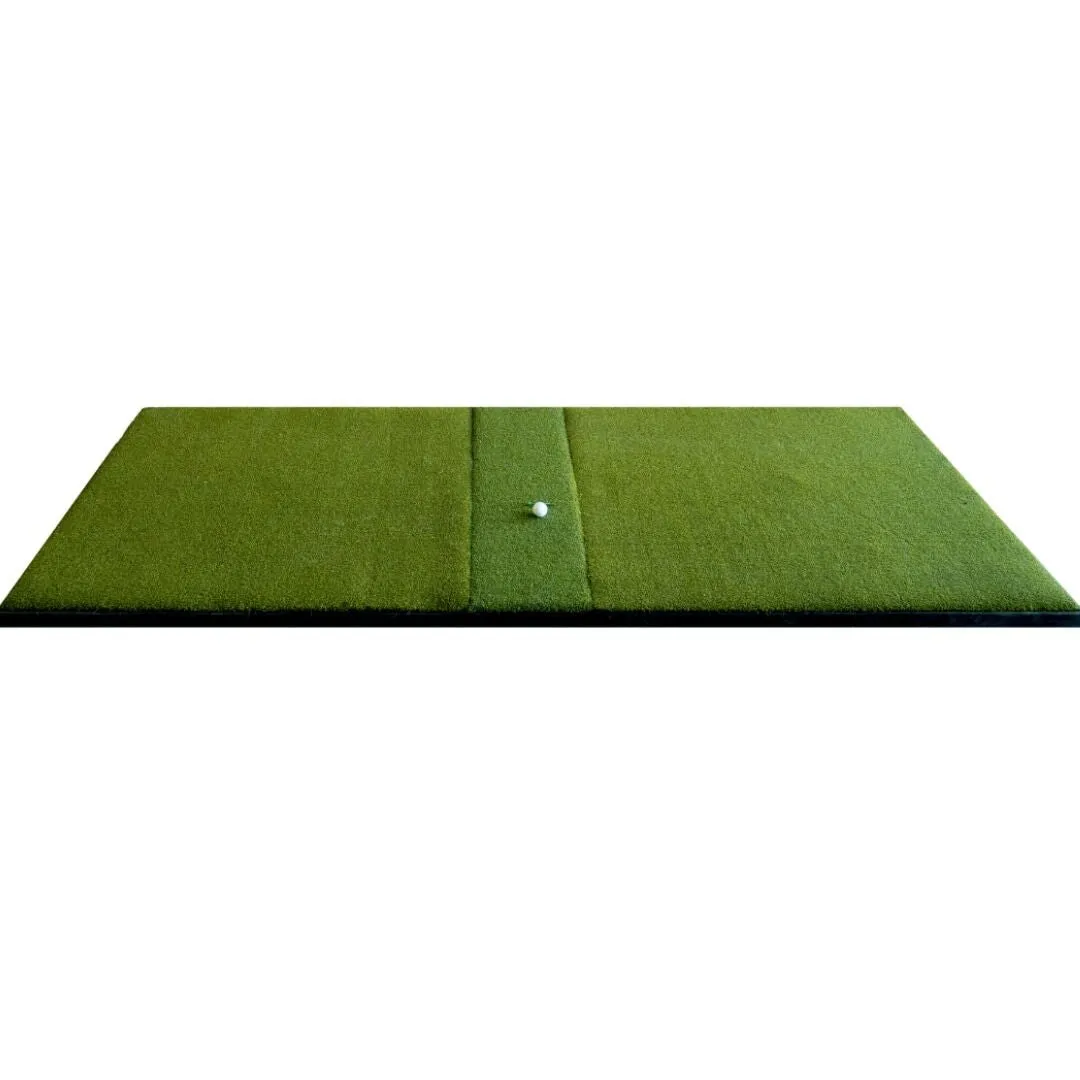
The SIGPRO Super Softy, from Shop Indoor Golf, is built for a different room. It is 4 ft by 9 ft, with a 12 inch by 48 inch Softy XL hitting strip in the center and a stance area on each side of it. Right handed and left handed golfers share it without moving anything, which is the feature that justifies the price for a household or a facility with both kinds of players. The strip takes a real tee, and it is replaceable, so when the strike zone wears out you swap the strip, not the mat.
Construction is the story. The strip is soft foam under Teeline turf with compression slots, built to cushion impact and give realistic feedback on fat shots. Underneath, heavy duty rubber tiles lock together into a base designed to stay in place. At 320 pounds, this is an install once mat, not a roll up mat.
The price, verified from Shop Indoor Golf on Oct 29, 2026, is $1,369.99 for the 4 by 9. A single sided 4 by 6 version, with one stance area instead of two, lists at $1,159.99 on the same page. The Super Softy carries a 1 year maker warranty on mats and strips, shorter than SwingTurf's 3 years, though the replaceable strip is the real long term value here.
Pro Turf: the net mat that also putts
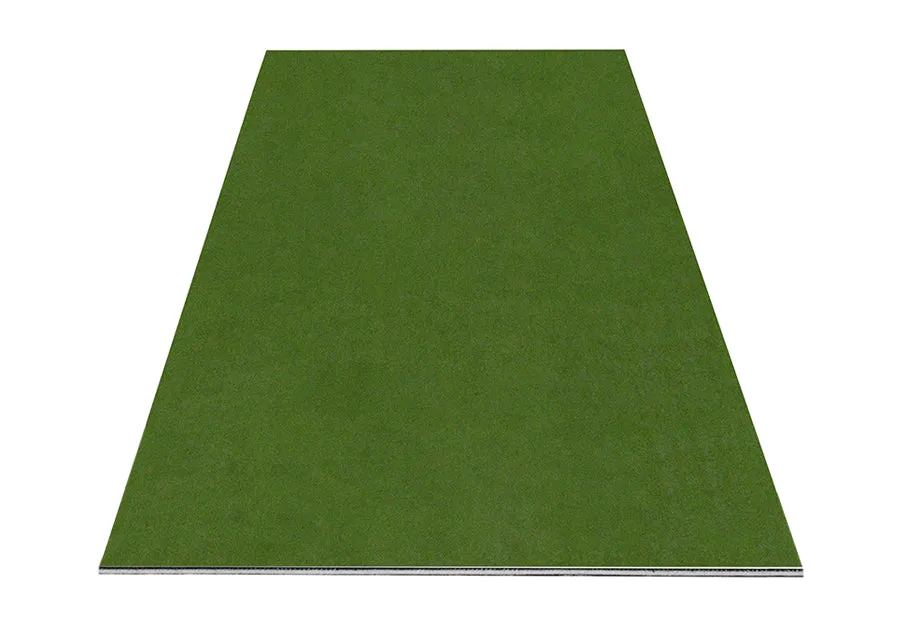
The Net Return Pro Turf is the odd one out, and that is its appeal. It is a single size, 6 ft by 10 ft, of 42 oz nylon turf over 5 mm foam backing, about 3/4 inch thick. It is designed to pair with Net Return nets, where the ball rolls back to you after every shot, and it rolls up like a carpet for storage when you are done. Two rubber tees are included.
The second job is putting. The same surface rolls at around 10 on the Stimpmeter, a medium fast green speed, so the 10 ft length doubles as a putting lane. No other mat in this comparison does that. The Net Return page suggests six 2 ft by 2 ft foam puzzle tiles under the hitting zone if the turf feels firm on concrete.
The price, verified from The Net Return on Oct 29, 2026, is $599. With only 5 mm of foam under the turf, expect the firmest feel of these three mats. It is cushioned compared with a bare floor or a thin range mat, but it is not in the same forgiveness class as SwingTurf's foam backed fiber or the Super Softy's soft strip. Rotate it to balance wear, or cut a hitting insert into the turf, since there is no replaceable strip.
Feel on a fat shot
This is where the three mats separate, and it is the section to read twice if your wrists or elbows already complain.
SwingTurf absorbs the strike into fiber and foam, and Rain or Shine pitches it directly as the answer to recoil and vibration. You still read a fat shot, because the fibers let the club pass through instead of bouncing it into the ball, but the punishment is muted. That is the right balance for a daily practicer who wants honest feedback without paying for it the next morning.
Super Softy goes further on cushion. The soft foam strip and compression slots are built to remove sharp vibration at impact, and the 48 inch strip gives you a deeper hitting zone than a standard strip. For a golfer with a wrist or elbow history, or a shared bay where many players hit every day, that extra cushion is the whole point.
Pro Turf is the firmest of the three and the most honest about it in a different way. Thin foam over a hard floor will tell you exactly when you hit it fat, because there is less material to hide behind. Some golfers prefer that. Most golfers with sore joints will not.
Our earlier Fiberbuilt vs TrueStrike comparison covered the premium end of this same question, and the lesson carries over: a mat that lies about fat shots teaches a swing that falls apart on grass, and a mat that punishes them teaches a swing that avoids pain.
Size, weight, and the room test
Measure your floor before you fall for a mat.
SwingTurf is the flexible pick. Four sizes from 4 by 4 to 4 by 9 cover tight corners through full bays, and even the largest size at 63 pounds can be moved by one person.
Super Softy is the permanent pick. At 4 by 9 and 320 pounds, it needs a dedicated bay. If your simulator room is also your living room, or if you rent, stop here.
Pro Turf is the portable pick. At 6 by 10 it is the largest surface of the three, but it rolls up and stores, and at around 50 pounds it is manageable. The catch is the length: 10 ft of turf plus a net behind it needs real depth, so it suits a garage or a basement bay better than a spare bedroom.
Our take
- Buy SwingTurf if you practice most days, want real tees anywhere on the surface, and want the best balance of feel, forgiveness, and price. The 5 by 5 at $549 as of Oct 29, 2026 is the default pick for a home simulator bay.
- Buy Super Softy if two golfers share the bay, especially a lefty and a righty, or if the mat will never move and you want a replaceable strip to carry the long term cost. Pay the $1,369.99 only if the bay is permanent, because at 320 pounds, it basically is.
- Buy Pro Turf if you practice with a Net Return net, want ball return without chasing balls, and want a putting surface in the same footprint. At $599, it is the cheapest way to get a 6 by 10 practice surface that disappears into a roll when guests come over.
Skip all three and look at the premium tier if your joints are already a problem and your budget stretches further. That is the Fiberbuilt and TrueStrike conversation, and it is worth having before you spend four figures on anything else.
Check the deal pages for each mat before you buy. The live price is the one that counts, and the right mat is the one your wrists still like after a thousand balls.
Sources: Rain or Shine Golf's SwingTurf product page for sizes, prices, and warranty, Shop Indoor Golf's Super Softy product page for the 4 by 9 price, strip size, and weight, and The Net Return's Pro Turf product page for the $599 price, putting speed, and ball return design.
Shop the post